Bread
Authentic German Pretzels Recipe (Soft Bavarian Laugenbrezeln)
By Trevor Farias · Updated · 2 hours 15 minutes total · 8 large pretzels
Loading ratings…
In a nutshell
Authentic German pretzels are made from a stiff, lightly enriched dough of bread flour, water, yeast, a little butter and malt or brown sugar. The dough is rolled into ropes thick in the middle and thin at the ends, twisted into the classic shape, chilled uncovered so a skin forms, then dipped in a strong alkaline bath before baking at 450°F. At home, a bath of baked baking soda gives the same dark, glossy, pretzel-flavored crust as traditional food-grade lye without the hazard.
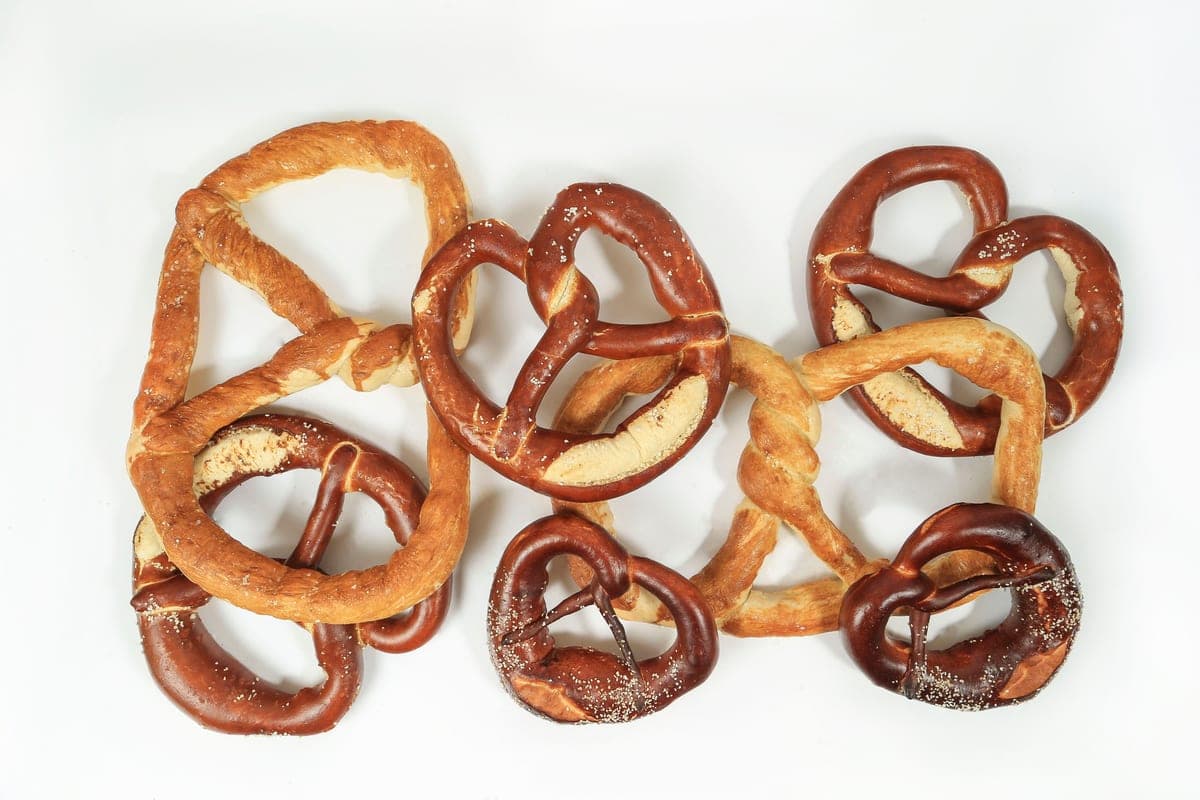
A real Bavarian pretzel is nothing like the mall kind. The crust is thin, dark and glossy with a flavor you cannot get any other way, the belly splits open to show soft white crumb, and the arms are thin enough to snap. They are eaten warm with butter or with sweet mustard and a Weisswurst, and they are much easier to make at home than they look.
The secret is the alkaline bath. German bakeries dip pretzels in a weak lye solution, which is caustic and not something to keep in a home kitchen. Baking ordinary baking soda for an hour turns it into sodium carbonate, a far stronger alkali than plain baking soda, and a hot bath of it gives nearly identical color and flavor.
The rest is technique: a stiff dough that holds a sharp shape, ropes rolled with a fat belly and thin ends, and a short rest in the refrigerator so the surface dries before dipping. Follow those three things and you will get pretzels that look like they came from Munich.
Why this recipe works
- A stiff, low-hydration dough holds the twisted shape and bakes with the tight, chewy crumb of a true Brezel.
- Baked baking soda (sodium carbonate) is strongly alkaline, so it browns the crust deeply and gives the classic pretzel flavor without lye.
- Chilling the shaped pretzels uncovered dries the surface, so they are easy to handle in the bath and the belly splits cleanly when scored.
- A hot 450°F oven sets the crust fast and keeps the thin arms crisp.
Ingredient notes
Bread flour gives the best chew; all-purpose flour works but the pretzels will be a little softer. Diastatic malt powder or barley malt syrup is traditional and helps browning; brown sugar is a good substitute. Use coarse pretzel salt if you can find it. Flaky sea salt works, but table salt dissolves into the crust and tastes harsh.
To make baked baking soda, spread 1/2 cup of baking soda on a foil-lined baking sheet and bake at 250°F for 1 hour. It loses about a third of its weight. Store it in a sealed jar labeled clearly; it keeps indefinitely. It is more irritating than regular baking soda, so wear gloves when handling the bath and avoid aluminum pots, which it will discolor.
How to shape a German pretzel
Roll each piece of dough into a 24-inch rope that is about 1 inch thick in the middle and tapers to thin, pencil-width ends. That fat belly is what gives a Bavarian pretzel its soft center and thin crisp arms. Lay the rope in a U shape, cross the ends over each other twice to make a twist, then fold the twisted ends down and press them onto the belly at about four and eight o'clock.
If the dough keeps springing back while you roll, cover it and let it rest for 5 minutes. The gluten relaxes and it will roll out easily.
What to serve with pretzels
- Soft salted butter, the way they are eaten at a Bavarian breakfast.
- Sweet Bavarian mustard or a sharp German mustard.
- Obatzda, the Bavarian beer-garden cheese spread made with Camembert, butter and paprika.
- Weisswurst, bratwurst or a cold beer.
How to store german pretzels
- Pretzels are best the day they are baked. Keep leftovers in a paper bag at room temperature for 1 day; plastic makes the salt weep.
- Freeze unsalted baked pretzels in a zip-top bag for up to 2 months. Reheat from frozen at 350°F for 8 to 10 minutes and salt after reheating.
Variations to try
- Pretzel rolls (Laugenbrötchen): shape the dough into 12 round rolls, dip, cut a cross in the top, and bake 16 to 18 minutes.
- Pretzel bites: cut ropes into 1-inch pieces, dip and bake 10 to 12 minutes.
- Cheese pretzels: skip the salt and sprinkle with shredded Gruyère or Emmental before baking.
Frequently asked questions
- Do German pretzels use lye?
- Bakeries in Germany dip pretzels in a weak food-grade lye solution. At home, a bath of baked baking soda gives nearly the same color and flavor and is much safer to handle.
- Why are my pretzels pale?
- Regular baking soda is a weak alkali. Bake it at 250°F for an hour first, keep the bath at a simmer, and dip for a full 20 to 30 seconds. A hot 450°F oven also matters.
- What is the difference between German and American soft pretzels?
- German pretzels have a darker, thinner crust, a fat soft belly with thin crisp arms, and less sweetness. American soft pretzels are usually larger, softer throughout, paler and often brushed with butter.
- Can I make the dough ahead?
- Yes. After kneading, refrigerate the dough covered overnight. Let it sit at room temperature for 30 minutes, then divide, shape and continue with the recipe.
Recipe card
Authentic German Pretzels Recipe (Soft Bavarian Laugenbrezeln)
An authentic German pretzel recipe: soft, chewy Bavarian Laugenbrezeln with a deep mahogany crust, thin crisp arms and coarse salt. Baked baking soda bath method, no lye needed.
By Trevor Farias · Updated
- Prep
- 45 minutes
- Cook
- 18 minutes
- Total
- 2 hours 15 minutes
- Makes
- 8 large pretzels
Includes about 1 hour of rising and 20 minutes of chilling
Ingredients
For the dough
For the bath and topping
Equipment
- Stand mixer with dough hook (optional)
- Wide stainless steel pot, not aluminum
- Slotted spatula or spider
- 2 rimmed baking sheets and parchment paper
- Kitchen gloves
- Sharp knife or bread lame
Instructions
Mix the dough
In a large bowl or the bowl of a stand mixer, combine the flour, yeast, salt and malt or brown sugar. Add the water and butter and mix until a shaggy dough forms. Knead by hand for 8 to 10 minutes, or with the dough hook on medium-low for 6 minutes, until smooth, firm and elastic. The dough should be stiff and not sticky.
First rise
Cover the bowl and let the dough rise in a warm place until puffy but not quite doubled, 45 minutes to 1 hour.
Divide and roll
Turn the dough out onto an unfloured counter and divide it into 8 equal pieces, about 3 1/2 ounces (100 g) each. Roll each into a short log, cover and rest 5 minutes. Then roll each into a 24-inch rope, thick in the middle and tapering to thin ends.
Tip: An unfloured counter gives the dough traction so it stretches instead of sliding around.
Shape
Form each rope into a U, cross the ends over each other twice, and fold the twisted ends down onto the thick belly, pressing lightly to attach. Place on two parchment-lined baking sheets.
Chill
Refrigerate the shaped pretzels, uncovered, for 20 to 30 minutes, until the surface feels dry and firm. Meanwhile, heat the oven to 450°F (230°C) with racks in the upper and lower thirds.
Dip in the alkaline bath
Bring the water to a simmer in a wide stainless steel pot and carefully stir in the baked baking soda; it will foam. Wearing gloves, lower one or two pretzels at a time into the bath for 20 to 30 seconds, turning once, then lift out with a slotted spatula, let drain and return to the parchment.
Score, salt and bake
With a sharp knife or razor blade, make one horizontal slash about 1/4 inch deep across the thickest part of each belly. Sprinkle with coarse salt. Bake for 15 to 18 minutes, switching the pans halfway, until deep mahogany brown.
Cool briefly
Let the pretzels cool on a rack for 10 minutes. Serve warm with butter or mustard.
Notes
- Bake the baking soda at 250°F for 1 hour before using for the darkest, most authentic crust.
- Keep the dough stiff; a soft dough loses the pretzel shape.
- Chill the shaped pretzels uncovered so they are easy to dip.
Nutrition (per serving, estimated)
| Calories | 270 |
|---|---|
| Fat | 5 g |
| Saturated fat | 3 g |
| Carbohydrates | 48 g |
| Fiber | 2 g |
| Sugar | 1 g |
| Protein | 8 g |
| Sodium | 1150 mg |
| Cholesterol | 11 mg |
Serving size: 1 of 8. Nutrition is calculated from standard ingredient data and will vary with brands and substitutions.
Recipe from Trevor's Kitchen · https://trevorfarias.com/recipes/german-pretzels
More recipes you might like
Bread
Easy Sourdough Bread Recipe for Beginners (Step by Step)
The best sourdough bread recipe for beginners: 4 ingredients, no kneading, and a crisp crust with a soft, open crumb.
- Total:
- About 24 hours
- Makes:
- 1 round loaf (12 slices)
Bread
Homemade Butter Croissants Recipe (Flaky, Bakery-Style)
A step-by-step homemade croissant recipe: flaky, buttery French croissants with a honeycomb crumb, made with three simple folds.
- Total:
- About 15 hours
- Makes:
- 12 croissants
Dinner
Juicy Loaded Cheeseburgers Recipe (Cast Iron, Bacon and Burger Sauce)
Juicy loaded cheeseburgers with a hard sear, melted cheddar, crispy bacon, caramelized onions and tangy burger sauce on toasted brioche.
- Total:
- 40 minutes
- Makes:
- 4 burgers